10 Minute Cleaning Routine for Every Day of the Week
A ten-minute cleaning routine is the most underrated tool in housekeeping. Ten minutes is short enough to start when you are tired, long enough to change how a room looks, and small enough that missing it does not matter. The trick is to know in advance what the ten minutes contain. A vague "tidy up for ten minutes" turns into scrolling. A list with minutes next to each job turns into a finished kitchen.
Below is a Sprint for every day of the week, taken from the Homekeel Cleaning Planner, where each weekday has a focus room and three sizes: Sprint (about 10 minutes), Steady (about 30) and Deep (about 60).
How to use these lists
- Set a timer for ten minutes.
- Do the tasks in the order shown.
- When the timer rings, stop. Even if you want to carry on.
- Tick the day. A Sprint is a full tick.
If you have more time and energy, choose Steady and add the extra tasks. If you start on Deep and the day goes sideways, stop at the Steady line. Sizes nest, so nothing is wasted.
Monday: kitchen (5 tasks)
The room you use most sets the tone for the week.
- Clear the sink; load or wash the dishes (3 min)
- Wipe the worktops (2 min)
- Wipe the hob top (2 min)
- Empty the bin if it is full (1 min)
- Sweep the crumbs off the floor (2 min)
Why it works: the sink and the worktops are the two surfaces your eye goes to first. Clear them and the whole kitchen reads as done.
Tuesday: bathroom (5 tasks)
Bathrooms get dirty fastest and feel best when done. Little and often beats one long scrub.
- Clear the surfaces; bin the rubbish (2 min)
- Spray and wipe the basin and taps (3 min)
- Quick toilet clean: bowl, seat, flush handle (3 min)
- Wipe the mirror (1 min)
- Hang towels; lift anything off the floor (1 min)
Why it works: two minutes of spraying and wiping is nothing compared with a monthly scrub.
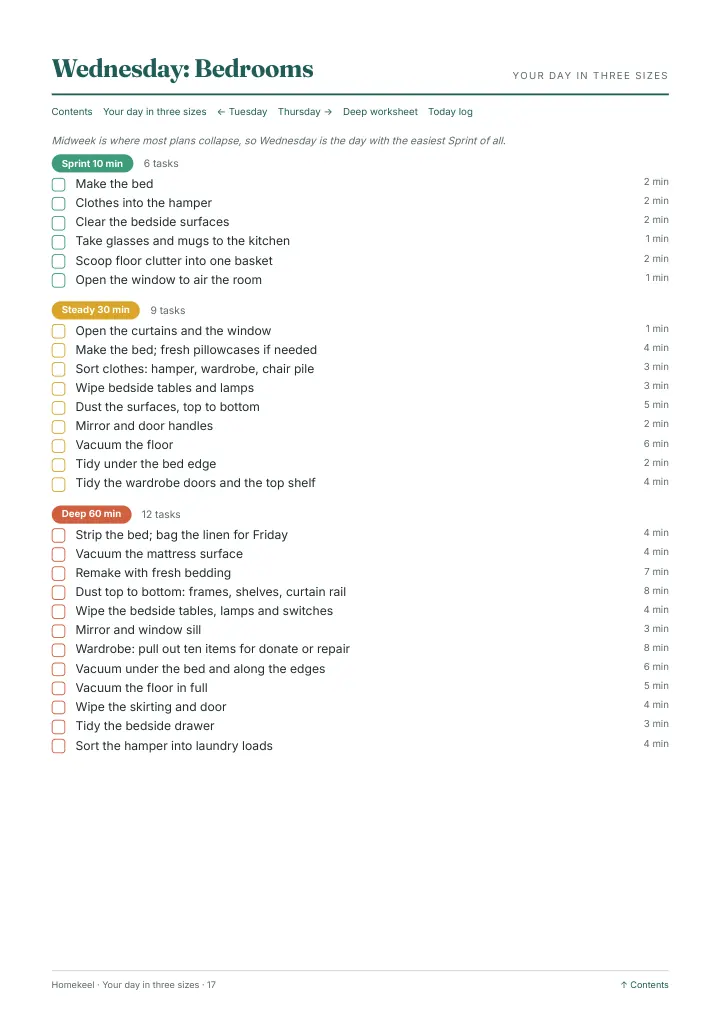
Wednesday: bedrooms (6 tasks)
Midweek is where most plans collapse, so Wednesday is the day with the easiest Sprint of all.
- Make the bed (2 min)
- Clothes into the hamper (2 min)
- Clear the bedside surfaces (2 min)
- Take glasses and mugs to the kitchen (1 min)
- Scoop floor clutter into one basket (2 min)
- Open the window to air the room (1 min)
Why it works: a made bed makes the whole room look finished, even in a Sprint.
Thursday: living room and floors (4 tasks)
The shared space that guests see. A clear floor and a wiped table change the whole room.
- Put out-of-place items back where they live (4 min)
- Plump the cushions; fold the throw (1 min)
- Clear the coffee table (2 min)
- Vacuum the main walking path (3 min)
Why it works: the walking path is the part of the floor that people actually see and feel.
Friday: laundry and linen (4 tasks)
Close the week with clean linen and an empty hamper, so the weekend starts light.
- Start one load of washing (2 min)
- Gather the hampers (3 min)
- Fold or hang what is dry (4 min)
- Wipe the machine door seal (1 min)
Saturday: entry, hall, desk and outdoors (5 tasks)
The first and last thing you see every day, plus the desk and the step that quietly get away from you.
- Shoes back into place (2 min)
- Clear the post and bags from the hall (2 min)
- Wipe the door handle (1 min)
- Shake the mat; sweep the entry (3 min)
- Take out the bins and recycling (2 min)
Sunday: reset and plan (5 tasks)
Not a cleaning day. A planning day, so Monday starts with a decision already made.
- Look back at last week's ticks (2 min)
- Choose a size for each day (3 min)
- Write your three priorities (2 min)
- Note what is running low (1 min)
- Clear one visible surface (2 min)
Making it stick
Writing the lists is the easy part. Here is what turns them into a routine.
Put it somewhere you will see it
Print the pages and keep the day pages in a folder on the kitchen side of the fridge. Stick the "Pick today's size" page inside a cupboard door. A routine you have to look for will not be done.
Choose a trigger
Ten minutes after the kettle goes on in the morning. Ten minutes after the children go to bed. Ten minutes while dinner is in the oven. A trigger removes the question of when.
Keep a streak, but a forgiving one
The planner has a 12-week streak tracker where you colour a circle for each ticked day: green for Sprint, gold for Steady, coral for Deep. Any colour is a streak day. This is important. A tracker that only rewards your best days punishes the ones that matter.
Track the five-minute habits too
Beyond the daily list, the planner has a minimum habits tracker: bed made, dishes done before bed, worktops clear, clothes in the hamper, five-minute tidy of the main room, bins out, floors clear, and me: a proper break.
What ten minutes cannot do
Honesty is better than a promise. Ten minutes a day will not deep-clean your oven or sort the loft. What it does is stop things getting worse and keep the home at a level where you are comfortable. The bigger jobs belong on a Steady or Deep day, or in the 52-week cleaning schedule where one deeper job gets its own week.
When ten minutes still feels like too much
Some days even ten minutes is a lot. Then do the first task on the list and stop. Or go to the Reset Day, which is built for the lowest-energy days. The page on cleaning motivation when you have no energy goes into this in more detail.
Where to go from here
If you like this approach, the next step is to see how all seven days fit together in the weekly cleaning schedule. And if you want to understand why a short day should count as a full day, the three-size cleaning schedule explains the thinking. Try tonight's list. Set the timer, do the tasks and tick the circle. Tomorrow, do the next one.