How to Keep Your House Clean Without It Running Your Life
You clean on Saturday and by Sunday evening the house is back to how it was. The worktop has a pile on it, the floor has collected shoes, and the sink has something in it. It feels like cleaning does not stick, which is unfair when you spent half the weekend on it. Keeping a house clean is not mainly about cleaning harder. It is about three smaller things: a daily minimum, a focus that rotates, and fewer things in the way.
Why a clean house does not stay clean
There are three common reasons, and they stack.
- Cleaning in bursts. A big clean makes the house look good for a day, and then there is nothing holding it. The thing that keeps a house clean is the small reset every day, not the big effort once a week.
- A plan with only one size. When the plan is long, any day you cannot manage it feels like a failure, so you skip the day and the mess builds.
- Too much stuff on every surface. More objects means more to move before you can wipe. Every surface you clear is a surface that stays clear more easily.
Step 1: Set a daily minimum
The daily minimum is what keeps the house working when everything else slips. In the Homekeel Cleaning Planner there is a tracker of eight minimum habits, ticked across the week:
- Bed made
- Dishes done before bed
- Worktops clear
- Clothes in the hamper
- Five-minute tidy of the main room
- Bins out
- Floors clear
- Me: a proper break
The last one is deliberate. A cleaning system that has no room for you to sit down will not last.
You do not need to do all eight every day. The point is that on the worst day of the week, you have a list of tiny things that hold the house together.
Step 2: Give each day a focus
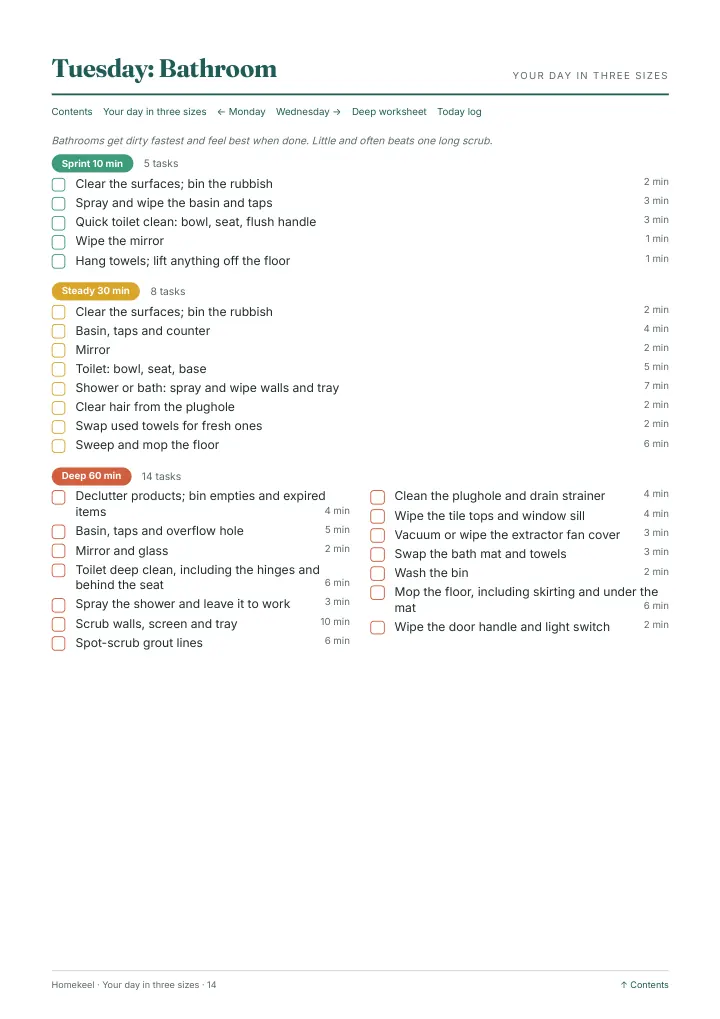
A house stays clean when different areas get attention on different days. A rotation also removes the daily decision about what to clean. A sensible week looks like this:
- Monday: kitchen
- Tuesday: bathroom
- Wednesday: bedrooms
- Thursday: living room and floors
- Friday: laundry and linen
- Saturday: entry, hall, desk and outdoors
- Sunday: reset and plan
The kitchen on Monday means the room you use most is in good shape for the week. Bathrooms on Tuesday get done while they are still manageable. Wednesday is bedrooms, and the plan makes the Sprint easy on purpose, because midweek is where most plans collapse. You can see the whole rotation in the weekly cleaning schedule.
Step 3: Make each day come in three sizes
The reason a rotation fails is that a fixed list does not flex. The Three Sizes Method gives each day a Sprint (10 minutes), a Steady (30) and a Deep (60). On Monday the Sprint is five tasks: clear the sink and load or wash the dishes, wipe the worktops, wipe the hob top, empty the bin if full, sweep the crumbs. That is the difference between a kitchen that is workable and one that has a week of mess in it.
Pick the size by energy and time, not by guilt. That rule is printed in the planner's Reset Week pages, and it applies every day.
Step 4: Do the reset at the right moment
For most households, the highest-value ten minutes of the day come in the evening. A short reset before bed means you wake up to a clear sink, clear worktops and a floor you can cross. The minimum habits above are built around that idea. If your morning is the bottleneck, make the evening reset the thing that saves you.
A useful pattern:
- Evening (5 to 10 minutes). Dishes, worktops, clothes in the hamper, a pick-up basket for strays.
- Morning (2 minutes). Open the curtains and windows, make the bed.
- One focus-day task. Whatever the day page says, at Sprint, Steady or Deep.
Step 5: Reduce what you have to clean
Every object on a surface is something you have to lift. This is why decluttering is part of keeping a house clean, not a separate hobby. The Homekeel planner comes with a bonus called Less Stuff, More Home: printable decision sheets for letting things go zone by zone, which means fewer objects to clean and put away. Do it a drawer or a shelf at a time. You do not need a weekend.
Step 6: Know what you do when the week falls over
It will. Someone gets ill, work gets busy, you go away. Houses of busy people are not clean because nothing went wrong; they are clean because there is a way back. The Reset Week section is the way back: diagnose why the week fell, do one Reset Day in the size you have, check the story you are telling yourself, and ease back in for seven days.
The no-blame rules in that section are worth reading even if you never buy a planner:
- A fallen plan is information, not failure.
- You do not repeat the missed days. You reset the minimum.
- Pick the size by energy today, not by guilt.
- One Reset Day is enough to restart the week.
- Tell the people you live with. Ask for one thing.
A standard you can actually keep
A house does not need to look like a photo. A home that functions is a good standard: the sink is clear, the bathroom is wiped, the laundry is moving, you can find the front door in the morning. People who set the standard at "spotless" give up. People who set it at "functional" keep going, and often end up with a cleaner home as a result.
If you are not sure what that looks like for you, try this for a week. Do the minimum habits and nothing else. At the end, ask what bothered you most. That answer tells you where to put your Steady and Deep days.
Share the load
A house stays clean far better when more than one person is involved. If you live with a partner, flatmates or children, this is a conversation, not a solo project. The Homekeel bonus Fair Share Household Split gives you printable sheets to agree who does what and write it down, which takes the weekly argument out of it. Even small children can take a ten-minute job.
The shortest version
If you want to keep the house clean with the least effort possible, here is the whole thing in five lines.
- Do the evening reset: dishes, worktops, hamper.
- Follow one focus a day at the size you have.
- Keep fewer things on the surfaces.
- Share the work.
- When a week falls over, reset the minimum and carry on.
For the day-to-day detail, the three-size cleaning schedule is where to go next. If the real problem is that you just do not feel like it, cleaning motivation when you have no energy is written for that.