Weekly Cleaning Schedule: A Day-by-Day Plan That Holds
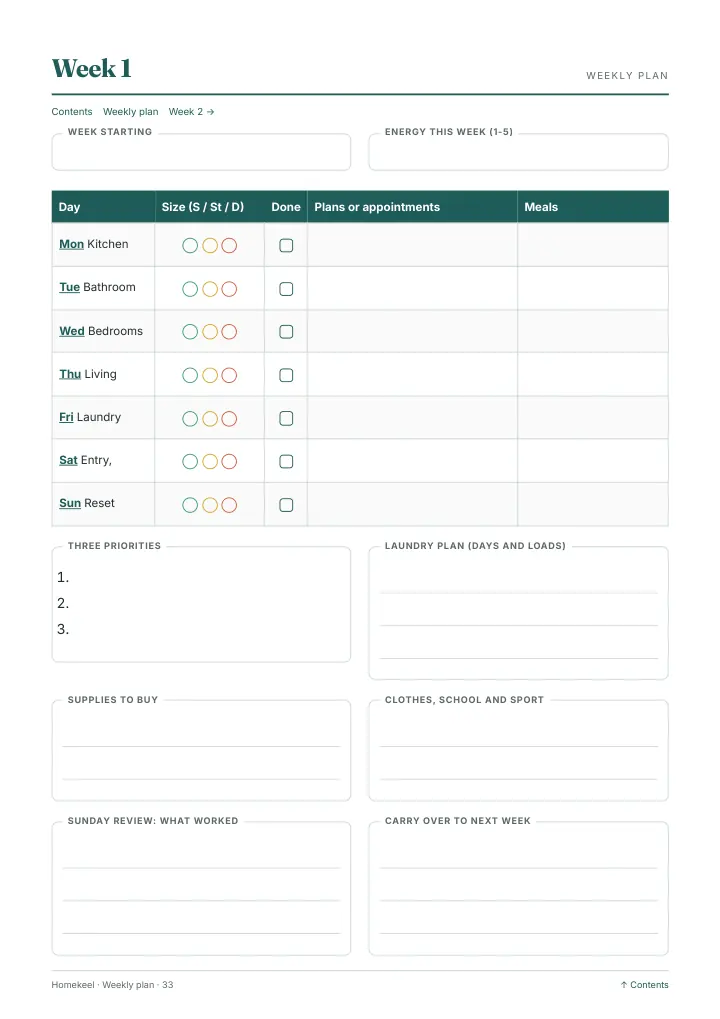
A weekly cleaning schedule works on a simple principle: you stop deciding what to clean and start following a pattern. One room, one day. The kitchen has its day, the bathroom has its day, and no day asks you to do the whole house. The problem is that most printable schedules give you one fixed list per day, and that list assumes an ordinary level of energy. Here is a version that adapts, with the full seven days laid out.
Why one room a day works
If you try to clean the whole house in one go, you need a free Saturday and a good mood. If you do a little every day, each job is small enough to start. A focus per day also solves the "where do I begin?" problem, which is where plenty of cleaning plans quietly die. You look at the house, you see everything at once, and you sit down.
The trick is to keep each day small and let the sizes flex. Every day in the Homekeel schedule has three versions of the same list, which you choose by how much time and energy you really have.
- Sprint: about 10 minutes, for tired days and short days.
- Steady: about 30 minutes, the default for a normal day.
- Deep: about an hour, when you have the time and some energy.
The task counts differ by day, so you can see the effort before you start.
The week, day by day
Monday: kitchen (5 / 7 / 11 tasks)
The room you use most sets the tone for every other day. The Sprint is clear the sink and load or wash the dishes, wipe the worktops, wipe the hob top, empty the bin if full, sweep the crumbs. Steady adds appliance fronts and handles, the microwave, a check of the top fridge shelf and a proper sweep and mop. Deep goes on to degrease the hob, wipe the splashback and tiles, spot-clean the oven, empty one fridge shelf and drawer, descale the tap and wash the bin.
Tuesday: bathroom (5 / 8 / 14 tasks)
Bathrooms get dirty fastest and feel best when done. Little and often beats one long scrub, so the Sprint is five small jobs: clear the surfaces and bin the rubbish, wipe the basin and taps, a quick toilet clean, wipe the mirror, and hang the towels.
Wednesday: bedrooms (6 / 9 / 12 tasks)
The plan's own note says midweek is where most plans collapse, so Wednesday has the easiest Sprint of all: make the bed, clothes into the hamper, clear the bedside surfaces, glasses and mugs to the kitchen, floor clutter into one basket, open the window. Six small jobs, about ten minutes, and the room looks done. The Deep version strips the bed, vacuums the mattress, dusts top to bottom, pulls out ten items from the wardrobe for donate or repair and vacuums under the bed.
Thursday: living room and floors (4 / 6 / 11 tasks)
The shared space guests see. A clear floor and a wiped table change the whole room. The Sprint is putting out-of-place items back, plumping cushions, clearing the coffee table and vacuuming the main walking path.
Friday: laundry and linen (4 / 7 / 10 tasks)
Close the week with clean linen and an empty hamper, so the weekend starts light. Start a load, gather the hampers, fold or hang what is dry, wipe the machine seal. If you want to take this further, a laundry schedule shows how to spread loads across the week.
Saturday: entry, hall, desk and outdoors (5 / 7 / 11 tasks)
The first and last thing you see every day, plus the desk and the step that quietly get away from you. Shoes in place, post and bags cleared, door handle wiped, mat shaken, bins and recycling out.
Sunday: reset and plan (5 / 7 / 9 tasks)
Not a cleaning day. A planning day, so Monday starts with a decision already made. Look back at last week's ticks, choose a size for each day, write three priorities, note what is running low, clear one visible surface.
How to fill in the weekly sheet
The weekly sheet is where the schedule becomes yours. The Homekeel planner has 26 undated sheets with a size circle per day, a "done" column, plans or appointments, meals, a laundry plan, three priorities and an energy rating for the week from 1 to 5. A Sunday session takes about ten minutes.
- Look at the calendar. Mark busy days as Sprint straight away.
- Choose a size for every other day.
- Write three priorities. They can be outside cleaning: a bill, a call, a fix.
- Plan the meals and the laundry day.
- Review: what worked, what slips into next week.
A pattern that works for many households is to start the week with one Deep, keep Steady for the middle and let the weekend be Sprint. Then adjust it.
A week that goes wrong, and a week that goes right
The wrong week. Monday you pick Deep and spend 70 minutes in the kitchen. Tuesday you are tired and skip the bathroom. Wednesday has no Sprint in your plan because you did not think you would need one. By Thursday you feel behind and the weekend is a pile of catching up.
The right week. Monday you check your energy, which is a 3, and pick Steady. Tuesday your child is ill, so you pick Sprint and the bathroom gets its two-minute wipe. Wednesday it is a Sprint again, six tasks, ten minutes, ticked. Thursday you have energy and do a Steady. Friday the laundry comes to life. Saturday is a Sprint. Sunday you plan. Nothing is missed, because every day got a tick at some size.
If you do fall over, there is a defined way back. The Homekeel planner has a Reset Week: do not repeat missed days, reset the minimum, pick the size by energy today and not by guilt. The page on cleaning a house in one day explains the idea.
Mid-day swaps
Real days change. The planner has a "mid-day swap" rule: chose Deep, then the day went sideways? Stop at the Steady line and tick Steady. Sizes nest, so nothing is wasted. That one rule removes the all-or-nothing feeling that makes people give up.
Matching the schedule to your home
Not every home has a bathroom day that needs 14 tasks. Adapt the focus days to your house.
- Small flat. Combine bedroom and living room into one day and use the spare day for a rotating deep job.
- Big family home. Keep the focus days as they are and pick Steady as your default.
- Working from home. The room checklists include a home office page with daily, weekly, monthly and seasonal jobs, so the desk gets its own slot.
- Pets. Add pet-safe product notes and extra floor passes to Thursday.
Where this schedule sits in the bigger picture
A weekly schedule keeps the house running. For the deeper jobs that build up over the year, there is the 52-week cleaning schedule, and for your overall structure there is the printable cleaning planner that holds all of this together. The point of the schedule is not to make you clean more. It is to make a cleaning day feel like something you can do, and to make sure the worst day of the week still counts.
If you want to see the layout before you commit, the sample page above is one of the real weekly sheets from the planner.