Cleaning Schedule: Why Every Day Needs Three Sizes
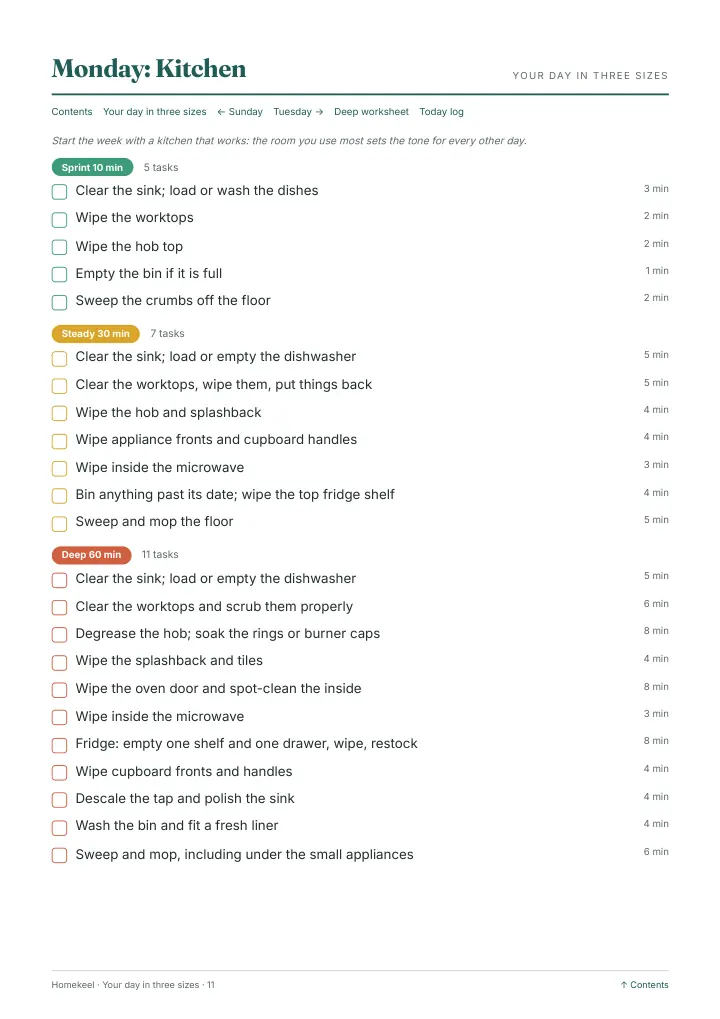
You wrote the cleaning schedule on Sunday night. Monday went well. Tuesday you were late home and did half. By Wednesday the chart on the fridge had gaps, you felt behind, and Thursday you stopped looking at it. By the weekend you were back to cleaning when the mess got bad enough to force you.
That is not a character flaw. It is a design flaw, and it has a name: the one-size trap.
The one-size trap
Most cleaning schedules are written for the perfect day. Every day has the same list, at the same length, assuming the same energy. That works while life is calm. But Wednesday arrives and it is not the day you planned for. You have ten minutes, the plan has no version of the day for ten minutes, the box stays empty, and an empty box reads as failure: "I could do this just fine yesterday." Next Sunday you start again.
Notice what failed. Not you, and not the cleaning. The plan only came in one size, and Wednesday was not that size.
Three things follow from that.
- A schedule should be built for the worst day, then scale up.
- The smallest version has to count, otherwise it is a trap in disguise.
- There has to be a way back when a week really does fall over.
The Three Sizes Method
The Homekeel Cleaning Planner is built on exactly this idea. Every day has a focus and the same list in three sizes.
| Size | Time | Use it when |
|---|---|---|
| Sprint | about 10 minutes | You are tired, short on time, or things went wrong. Under 20 minutes of real time, or an energy of 1 or 2 out of 5. |
| Steady | about 30 minutes | A normal day. 30 to 45 minutes and an energy of 3. This is the default. |
| Deep | about 60 minutes | You have time and some energy. An hour or more and an energy of 4 or 5. |
It is a 30-second decision at the start of the day, printed on one page ("Pick today's size"). You choose, you tick the circle for that day on the weekly sheet, and any size counts. The streak is about turning up.
The sizes nest
This is the detail that makes it work. Sprint is a subset of Steady, and Steady is a subset of Deep. If you choose Deep and the day goes sideways, you stop at the Steady line and tick Steady. If you only finish Sprint, you tick Sprint. Nothing is wasted and nothing is a failure.
What the lists look like
Take Tuesday, bathroom.
- Sprint (5 tasks): clear the surfaces and bin the rubbish, spray and wipe the basin and taps, a quick toilet clean (bowl, seat, flush handle), wipe the mirror, hang the towels.
- Steady (8 tasks): the Sprint basics plus the toilet base, a spray and wipe of the shower or bath, clearing hair from the plughole and swapping used towels for fresh ones.
- Deep (14 tasks): all of that plus sweeping and mopping the floor and decluttering products, binning empties and expired items.
Each task has the minutes beside it, so you can see at once what fits into the time you have. The sample page above shows exactly this layout, so you can judge it for yourself.
Take Wednesday, bedrooms. The Sprint is six small jobs: make the bed, clothes into the hamper, clear the bedside surfaces, glasses and mugs to the kitchen, floor clutter into one basket, open the window. About ten minutes and the room looks done.
How to build your own three-size schedule
If you want to do it yourself, here is the method.
Step 1: Pick a focus for each day
Seven days, seven focuses. Keep each focus to one area so you are never facing the whole house. The Homekeel week is kitchen, bathroom, bedrooms, living room and floors, laundry and linen, entry/hall/desk/outdoors, and a planning day.
Step 2: Write the Sprint first
The Sprint is the bare minimum so the room still functions. Aim for four to six tasks that add up to about ten minutes. If you cannot do it while tired, it is too big.
Step 3: Build Steady on top
Add the next layer of jobs. Steady should feel like a normal day and take 30 minutes or so. It should include the Sprint tasks.
Step 4: Build Deep on top of that
Add the slower, satisfying jobs: the oven door, the skirting, the mattress. This is the version you do when you have the energy and it feels good, not the version you feel you ought to do.
Step 5: Put the minutes next to each task
This is the step most people skip, and it is the one that stops the schedule being a wish list. If you do not know that wiping the hob takes two minutes, you will not do it in a Sprint.
Step 6: Plan the way back
Decide in advance what happens when you miss three days. Write it down. Ours is: do not catch up, do one reset day, ease back in for seven days.
What a normal week looks like
The idea is that you flex. A realistic week might look like this.
- Monday, energy 3: Steady, kitchen.
- Tuesday, energy 2: Sprint, bathroom.
- Wednesday, long meeting: Sprint, bedrooms.
- Thursday, energy 4: Deep, living room and floors.
- Friday: Steady, laundry.
- Saturday: Sprint, entry and hall.
- Sunday: Steady, planning and one visible surface.
Nothing was missed, and every day carries a tick. The streak tracker in the planner uses colours (green, gold, coral), and any colour counts as a streak day. The aim is to keep the week unbroken, not to make every day equal.
What if I still fall behind?
Then you use the part of the system designed for it. The Reset Week section begins with a message you do not often see in a cleaning plan: "You skipped Monday. Then Tuesday. By Thursday the home is a mess and the plan feels broken. This section is the way back, in one day." The idea is explained in more detail in how to clean a house in one day. If motivation is the problem rather than time, the page on cleaning motivation is the better starting point.
The standard to aim for
A schedule works better when it has a realistic target. The goal is a functional home, not a spotless one. A home where the sink is clear, the bathroom is wiped, the laundry is moving and you can find your keys is a home that works. That standard is easier to hit and, more importantly, easier to keep.
Is a printable the right format?
For most households, yes. A schedule on paper on the fridge is hard to ignore, and ticking a circle is satisfying. The Homekeel planner is 130+ printable A4 pages that also open in a notes app if you prefer a tablet. If you want a deeper look at what such a planner should hold, read what a good printable cleaning planner includes.
Start small
If you take one thing from this page, make it this: write a ten-minute version of tomorrow. Five tasks. Put it where you will see it. Do it tomorrow, tick it, and notice that the day still counted. That is the beginning of a schedule that lasts past Wednesday.