Laundry Schedule Printable: A Weekly Cycle That Works
Laundry has a particular kind of pressure. The hamper fills in the background, nobody sees it until it overflows, and then a Saturday disappears into washing, drying and folding. The cure is not working harder on Saturday. It is a laundry schedule that spreads the loads across the week so the mountain never forms.
The idea: one load most days
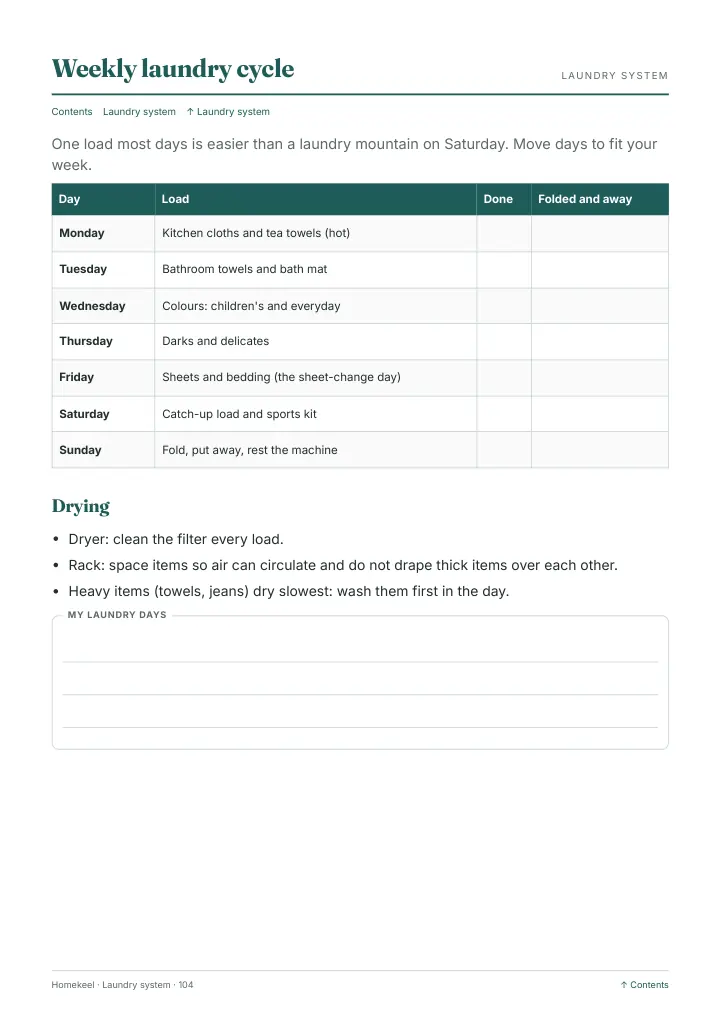
A weekly laundry cycle gives each day a type of load. You are not washing more, just spreading it out and making the decision once instead of every day. The Homekeel Cleaning Planner has a Laundry system section with a weekly cycle that looks like this, and it says plainly to move the days to fit your week.
| Day | Load |
|---|---|
| Monday | Kitchen cloths and tea towels (hot) |
| Tuesday | Bathroom towels and bath mat |
| Wednesday | Colours: children's and everyday |
| Thursday | Darks and delicates |
| Friday | Sheets and bedding (the sheet-change day) |
| Saturday | Catch-up load and sports kit |
| Sunday | Fold, put away, rest the machine |
The pattern follows the rest of the week: Monday is kitchen day, Tuesday is bathroom day, Wednesday is bedrooms, and Friday is laundry and linen. So the cloths go through on the day you clean the kitchen, and the towels on the day you clean the bathroom. Each load joins up with a room.
You can see how the days connect in the weekly cleaning schedule.
Make Friday the sheet-change day
Friday in the planner is laundry and linen. The Sprint is four tasks: start one load, gather the hampers, fold or hang what is dry, wipe the machine door seal. Steady adds sorting and a full load put away, and Deep takes in a full set of loads. Bed linen is the biggest laundry job of the week, so it makes sense for it to have a fixed day.
The five-minute sheet change
The planner sets out a fast routine.
- Strip the bed; the pillowcases go in the hamper.
- Vacuum the mattress.
- Fitted sheet, flat sheet, duvet cover and pillowcases on.
- Fold the throw; plump the pillows.
- Start the machine with the used set.
And a tip that saves arguments: keep two spare sets per bed. The clean set is always ready, so changing is never held up by the wash.
How often
A fresh set every one or two weeks is a good default. The planner has a sheet change schedule with a column for each bed, who changes it and the interval in weeks, plus tick boxes for twelve weeks. In a shared house, putting a name next to a bed is the simplest way to stop it being everyone's job and nobody's.
Drying matters as much as washing
The drying notes are short and practical.
- Dryer: clean the filter every load.
- Rack: space items so air can circulate, and do not drape thick items over each other.
- Heavy items (towels, jeans) dry slowest: wash them first in the day.
That last point changes how you order a day. Put the towels in first, and by the time you have done the other loads they have had the longest to dry.
Stain basics
A stain page is the sort of thing you only want when you need it, so it belongs in the planner next to the schedule. The format is first move, then second move, with the standing instruction to check the care label and test on a hidden spot first.
| Stain | First move | Then |
|---|---|---|
| Tea or coffee | Rinse in cool water; blot | Pre-treat with liquid detergent; wash as the label says |
| Red wine | Blot, do not rub; cool water | Pre-treat; wash. Act quickly |
| Grease or oil | Blot; sprinkle with bicarbonate or talc | Rub in washing-up liquid; wash warm if the label allows |
| Blood | Cool water only; never hot | Pre-treat with detergent; wash cool |
| Grass | Pre-treat with liquid detergent | Wash; repeat if it shows |
| Mud | Let it dry, then brush off | Rinse and wash |
The same page covers ink, sweat marks, chocolate or food and more. The short version: act early, use cool water on protein stains and test first.
Reading care labels
Care labels use symbols that most of us half-remember. The planner has a decoder that gives each in words, with a space to note your own. A tub with a number is the maximum wash temperature, so do not exceed it, and when unsure wash cooler. A tub with a hand means hand wash only in lukewarm water with no wringing. A crossed tub means do not wash; dry-clean or spot-clean. A triangle is bleach (open allows bleach, crossed does not). A square with a circle is tumble dry, with dots showing the heat, and a crossed one means dry flat or on the rack. The rules of thumb: cotton and linen are the most robust, wool and silk gentle only, and new dark clothes should be washed separately.
Track the loads
The 12-week laundry tracker has columns for whites, colours, darks, towels, sheets, delicates and extra, so you can tick each load finished: washed, dried, folded, away. There is a line for "what I will do differently", which is where you spot the pattern of, say, always skipping the delicates.
How the laundry area fits into the rest
The room checklists include a laundry area page, and the 52-week rotation touches laundry a few times a year. The daily laundry jobs are small: check the hamper and start a load if it is full (2 min), bring clothes out of the machine (2), fold the rack away (1). Weekly, wipe the machine door and seal, the detergent drawer, fold and put away, and empty the lint filter. The seasonal ones come from the 52-week cleaning schedule, where the washing machine drum, seal, drawer and filter get a full week and the dryer lint area another.
Make your own
If you want to write a schedule yourself, here is a quick method.
- Count your households' loads. Towels, bedding, cloths, work clothes, school kit, sports kit.
- Match each type to a day. Link it to the room you are cleaning that day.
- Put the slowest-drying loads first.
- Choose a fixed day for sheets.
- Keep a catch-up slot. Saturday works for many.
- Leave one day for the machine to rest.
Use pencil. The first version never survives contact with a real week, and moving a day is part of the process.
When the laundry gets away from you
It will, sometimes. A week of illness or travel and the hamper turns into a hill. Do not try to clear it in one go. The Reset Day for a Steady day starts one load of washing, and the Deep version gathers and starts two. After that, go back to one load a day. The page on how to clean a house in one day covers resetting the rest of the home after a bad week, and the printable cleaning planner overview shows where the laundry system sits among the other sections.
The payoff
A working laundry cycle gives you your Saturday back. It means no "I have nothing to wear" panic, no sheets that wait three weeks and no towel pile on the landing. It is one of the quieter wins in a cleaning system, and one of the most noticeable.