Cleaning Checklist Printable: Room by Room, by Time
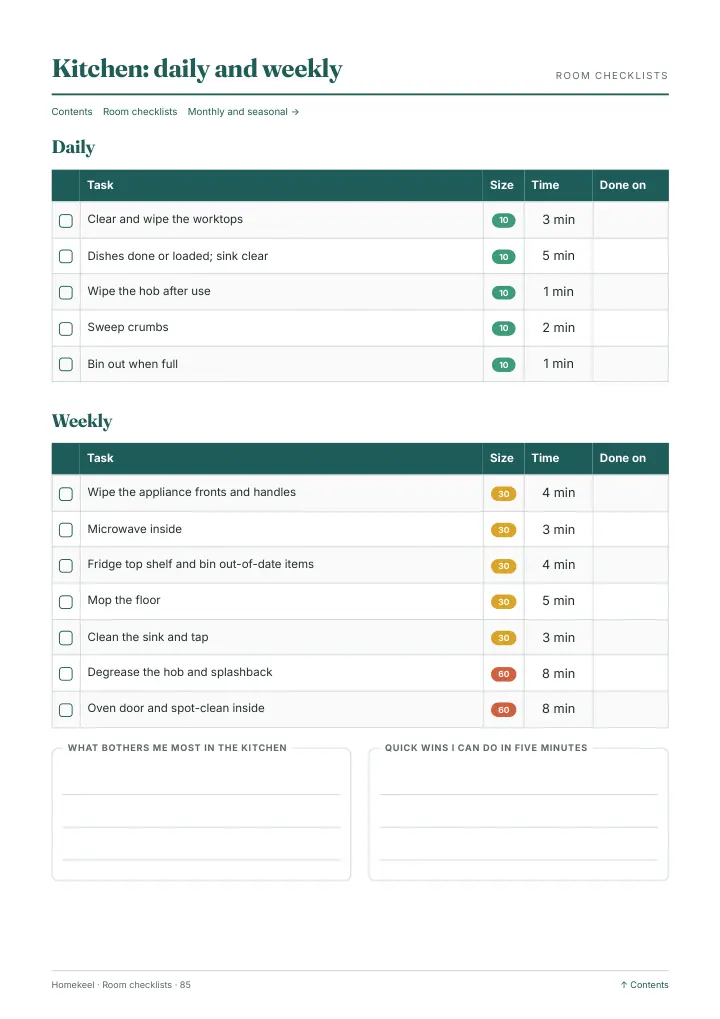
A cleaning checklist is a different tool from a cleaning schedule, and mixing them up is why many printables disappoint. A schedule tells you what to do today. A checklist tells you everything a room needs, so nothing gets forgotten for six months. The best way to use a printable checklist is to build it around time, so each line tells you how long it takes and how big a day you need to do it.
What makes a checklist usable
Most downloadable checklists share a flaw. They list thirty jobs for the kitchen in one block, and the reader's eyes slide off the page. A usable room checklist is organised by how often and by how long.
- Daily: a one to five minute reset. These are the jobs that keep the room working.
- Weekly: the proper cleaning, usually on the room's focus day.
- Monthly and seasonal: the jobs that stop dirt from building up.
And next to each job, a time estimate and a tag. In the Homekeel Cleaning Planner each task shows the smallest size at which it belongs: 10 for the Sprint jobs, 30 for Steady and 60 for Deep. So on a bad day you can scan down the 10s and ignore the rest without guilt.
Room by room: what goes on each page
The planner has nine rooms with two pages each (daily and weekly on the first, monthly and seasonal on the second). Here is a sense of what is on them.
Kitchen
Daily: clear and wipe the worktops (3 min), dishes done or loaded and the sink clear (5 min), wipe the hob after use (1 min), sweep crumbs (2 min), bin out when full (1 min). Monthly: one fridge shelf and one drawer, rotated (10 min), descale the kettle and the tap (6 min), wipe cupboard fronts (8 min), wash the bin and the lid (4 min).
Living room
Daily: cushions plumped and throw folded (1 min), coffee table clear (2 min), items back to their rooms (4 min), remotes and mugs away (1 min). Weekly: dust shelves and the TV unit, vacuum the floor and sofa edges, mop hard floors, wipe switches and doors, mirrors and glass tops.
Main bedroom and kids' room
The main bedroom daily list is make the bed, clothes into the hamper, bedside clear and open the window for five minutes; weekly adds changing the sheets (12 min), dusting, vacuuming, bedside tables and the mirror. The kids' room daily list is toys into one basket (3 min), clothes into the hamper, the bed straightened, and plates and cups to the kitchen.
Bathroom
Daily: wipe the basin after use, hang the towels, squeegee the shower screen if you have one, lid down and bin check. The weekly list adds the heavier cleaning, and the monthly and seasonal page holds the jobs that stop build-up.
Entry and hall
Daily: shoes in place, post and bags cleared, keys, wallet and bags in the drop zone. Monthly: declutter the shoe rack (10 min), wash the mat (8 min), wipe the door and glass, clean skirting and stair edges. Seasonal: swap coats, boots and scarves for the season (25 min) and wipe radiators or vents.
Home office
Daily: clear the desk of cups and wrappers, sort paper into one tray, wipe the desk surface. Monthly: declutter one drawer, dust the shelves and tech, wipe the chair and arms, back up files and clear the downloads folder. Seasonal: review paper files, clean behind the desk and the cable box, check supplies.
Laundry area
Daily: hamper checked and one load started if full, clothes brought out of the machine, rack folded away. Weekly: wipe the machine door and seal, the detergent drawer, fold and put away, empty the lint filter.
Outdoor and balcony
Daily: check the doors and bring in anything left out, sweep the step, water the plants if they need it. Weekly: sweep the balcony or patio, wipe the table and chairs, bins and recycling, clear leaves from the drain. Seasonal: put away or cover furniture for winter, check the guttering and drains, deep-wash the patio or deck.
How to use a checklist without it using you
The risk with a long checklist is that it becomes a stick. Here is how to keep it a tool.
- Do the daily list only. For the first week, ignore weekly and monthly. Ten minutes of dailies does more than people expect.
- Add the weekly list on the room's focus day. If kitchen is Monday, the kitchen weekly list lives on Monday.
- Put one monthly job in each Steady or Deep day. Not all of them. One.
- Tick as you go. The "Done on" column lets you write the date, so you can see when you last did the oven.
- Use the tag. If you have 10 minutes, do the 10s.
Using a checklist with a schedule
On its own, a checklist is a reference. It becomes a system when it feeds a schedule. The day pages in the Homekeel planner tell you what to do today in three sizes, and the room pages hold everything else. The weekly cleaning schedule guide shows how one focus per day uses the room pages, and the 52-week cleaning schedule shows how the monthly and seasonal jobs get spread across the year.
Making the checklist yours
Every room page in the planner has a section headed "What bothers me most" and "Quick wins I can do in five minutes". Fill these in. The first tells you where the real pressure is, and the second gives you a short list for when the doorbell goes. You will find that you personalise the list within a couple of weeks: crossing off jobs that do not apply, writing in the ones that do.
Some examples of useful additions:
- A pet. Add "wipe paws mat" and "brush the sofa" to the entry and living room.
- A baby. Add bottle sterilising to the kitchen daily list.
- A shared house. Put names against the weekly jobs.
- A rented flat. Add "check for damp" to the monthly list for the bathroom and cupboard under the sink.
How many pages do you need?
If you do the sums, a typical home needs nine rooms, two pages each, which is 18 pages of checklist. The planner these come from has 130+ pages, because the checklists sit alongside the weekly sheets, the 12-month view, the laundry system, a supplies inventory and the reset section. You can print only what you need. See the printable cleaning planner overview for how the pieces fit together.
A note on safety
A checklist often tells you what to clean, but not how to do it safely. A good one carries the basics: never mix cleaning products (bleach with ammonia, vinegar or acid cleaners makes harmful gas), ventilate, test new products on a hidden corner, read the label, and keep products in their original containers out of reach of children and pets. The Homekeel planner puts those rules in a "Safety first" page near the front and again in the supplies section.
Start with one page
Print the kitchen daily page. Stick it inside a cupboard door. For one week, tick what you do. That is enough to show you what a checklist can do, and it makes the next page easy to add.