Brain Dump Template: Layout, Categories and Method
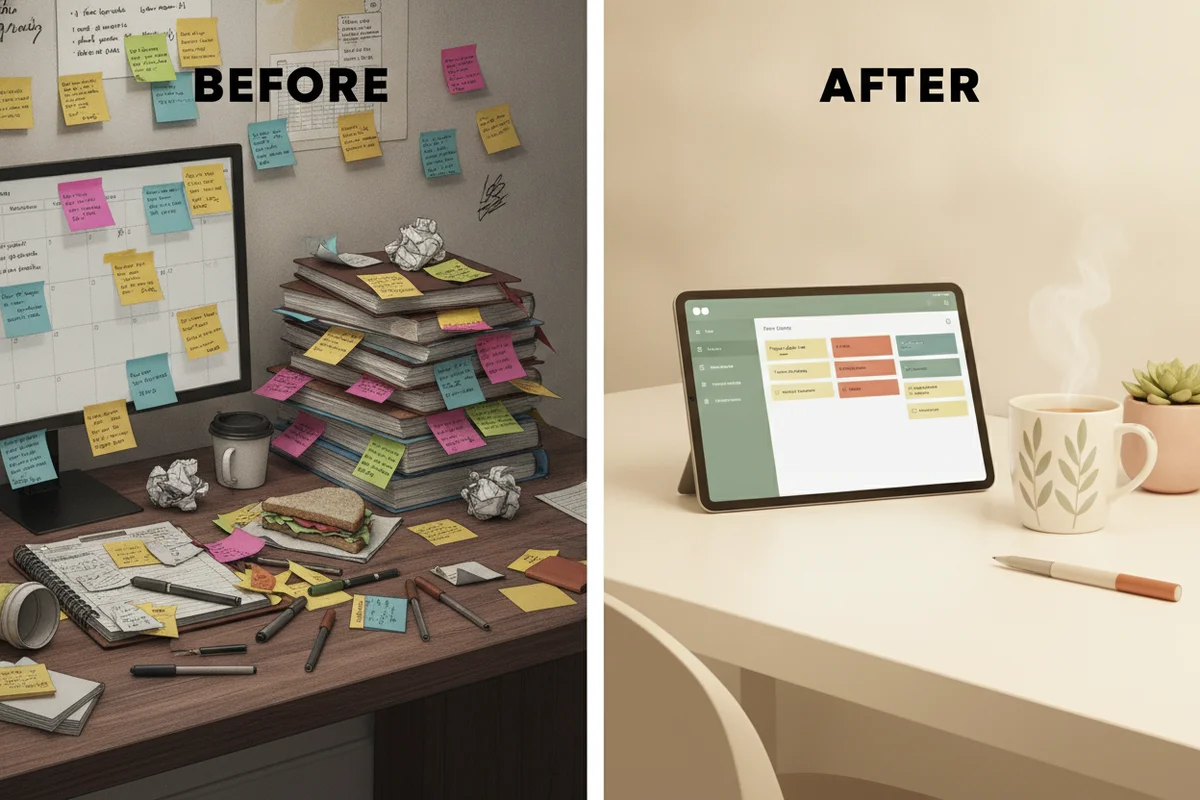
A brain dump template is a page with a few sections that let you empty your head quickly and then sort what you wrote. The layout below works on paper, in a notes app or in a PDF planner. Follow the ten-minute method and you will end up with a short, usable list instead of a long, stressful one.
What a brain dump is for
Your mind is good at having ideas and bad at storing them. Open loops, such as "call the dentist" or "what should we do about Mom's birthday", return again and again until they are written down. A brain dump closes that loop by putting everything in one external place. The goal is not to be organized yet. The goal is to see it all.
The basic layout
Use one page, split into a big free-writing area and a small sorting strip:
- Free-write area: the biggest part of the page. Write anything, in any order.
- Today / This week: a small box for items you must do soon.
- Dates: a small box for items with a deadline or appointment.
- Waiting on: things other people owe you.
- Someday: ideas for later.
Having the sorting boxes on the same page cuts the friction of moving items elsewhere. If the page feels too structured, use a plain page and sort after.
Categories that work
If you want categories, keep them few. These cover most lives:
| Category | Examples |
|---|---|
| Work / school | Emails, assignments, projects |
| Home | Cleaning, repairs, groceries |
| People | Calls, gifts, favors, birthdays |
| Money | Bills, forms, budgets |
| Health | Appointments, prescriptions, exercise |
| Me | Hobbies, rest, learning |
| Ideas | Things to explore later |
More than seven categories become a filing project. If an item fits two, choose the one where you would look for it.
The 10-minute method
- Set a timer for 10 minutes. The limit keeps it from turning into a second job.
- Write without stopping. Short phrases are fine. Do not edit.
- Stop at the timer. If more comes up, make a second pass later.
- Circle the real tasks. Anything you can act on gets a circle.
- Sort. Put each circled item in a box: today, this week, dated, waiting, someday.
- Choose three. Pick the three most important items and write them on today's page.
- Delete what is expired. Cross out items that no longer matter.
You can do this at the start of the day, at the end of the week, or whenever you feel overloaded.
Why sorting is the part that counts
Dumping alone can make you feel better for an hour and worse by evening if the list is still a mess. The sorting step turns a heap into decisions: do, schedule, wait, someday or delete. If you do only one thing after a dump, ask of each item "what is the next physical action?" and write that down. "Plan trip" becomes "search for flights on Friday".
Using a brain dump in a planner
A planner is a good home for the output. Capture the dump on a notes page, move this-week items to your weekly spread and dated items to the monthly calendar. In PlanBloom All-in-One Digital Planner, notes pages sit at the end of the planner and the week pages link from the monthly view. The Companion app also has a brain dump tool that lets you type items and sort them, so you can capture on your phone and sort at your desk. Learn more about the weekly routine in how to use a planner.
What is included in the planner, and what is separate
The planner and Companion app give you notes pages, 48 tabbed notebooks and 120 paper templates you can use as dump pages. A dedicated Brain Dump Bundle of 49 pages is sold separately as part of a different bundle; you do not need it to start. A plain notes page and the ten-minute method are enough.
If you have trouble focusing
Brain dumping is popular with people who find their thoughts racing or hard to hold. Used well, it frees attention for one task at a time. It is a technique, not a medical treatment, so if attention difficulties are affecting your daily life, talk to a qualified professional. For a longer look at planner layouts for scattered days, see ADHD planner digital.
Tips
- Keep it handy. Have a notes page open or a notebook nearby so you can capture a thought in seconds.
- Do not tidy. Pretty is not the goal.
- Pair it with the weekly review. A brain dump before planning makes the plan realistic.
- Reuse. Date each dump and keep them; you will see patterns, such as the same task showing up week after week.
- Pair with a home system. If your dumps are full of household items, a home management binder gives them a permanent place.
For the full system around the dump, read how to organize your life.
A filled-in example
Here's what a quick dump might look like after ten minutes: "call dentist, renew car registration, mom's birthday gift, reply to Sam about Friday, laundry, dentist form, budget for March, idea: weekend trip, fix bathroom light, ask landlord about the lease, groceries". After sorting, "call dentist" and "dentist form" become one task for this week; "mom's birthday gift" goes on the monthly calendar with a purchase-by date; "reply to Sam" goes on today's list; "idea: weekend trip" goes to someday; "ask landlord" goes to waiting on once you've sent the message. Eleven loose thoughts become five clear next actions.
Mistakes to avoid
- Dumping and never sorting. The list just becomes a bigger source of stress.
- Writing in full sentences. Short phrases are faster and enough to jog your memory.
- Mixing the dump with your calendar. Keep the dump as scratch space; move only the sorted items.
- Doing it too rarely. A weekly dump is easier than a quarterly one.