Planner for Busy Moms: One Page for the Whole Family
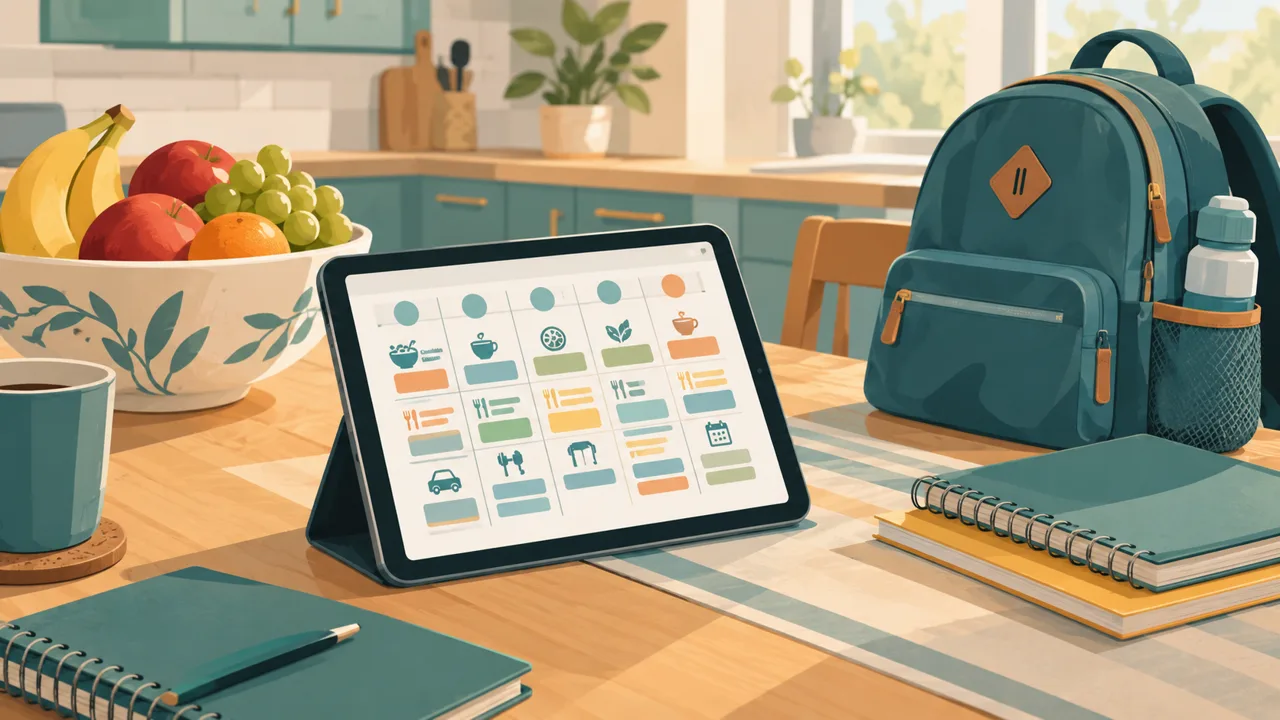
You are not disorganised. You are running a household without a system. The school run, the work call, the dentist, the packed lunches, the thing in the group chat you forgot to reply to: all of it lives in your head. A planner for busy moms is not about doing more. It is about getting it out of your head, so you stop being the household's only memory.
This guide covers how to set up one planner for the family, how to plan meals and routines without it becoming a second job, and how to keep a little space for yourself. It is built for real weeks, not for a perfect Sunday.
What makes a mom's planner different
A planner built for an office worker tracks meetings and tasks. A household runs on different rhythms:
- Many people's schedules, one person coordinating. You hold the school calendar, the activities, the appointments and your own work.
- Daily repeating tasks that nobody sees. Meals, laundry, packing bags, forms.
- Interruptions as the default. A good plan is one that survives a sick child on Wednesday.
- Almost no free time. The planner must be fast, or it will not be used.
That tells us what to look for: a clear day view, meal planning that feeds a shopping list, routines that run themselves, a calendar that is quick to scan, and room for a little time that is yours.
The day dashboard: one page for the whole day
The key is one place to look. A good day page for a busy household shows:
- Schedule. Who needs to be where, and when. School start, pickup, the 4:30 practice, your call at 2:00.
- Top three. What must happen today. Not twelve things; three.
- Tasks. The rest, including what slid from yesterday.
- Meals. Tonight's dinner, with a note if something needs defrosting.
- Habits. One or two small ones: water, a walk, ten minutes of quiet.
- Check-in. Two lines at night: what worked, what you'd change.
When all of that sits on one page, you stop checking six places. When you open your phone at 7:15 you know what the day is.
Meals: the single biggest relief
If you do one thing, plan dinners for the week. It removes the daily "what are we eating?" and reduces food waste and spending.
A simple method:
- Choose a theme for each night. Monday pasta, Tuesday tacos, Wednesday leftovers, Thursday sheet-pan, Friday pizza, and so on. Themes reduce decisions.
- Write in a real dinner for each. Two or three weeks' worth of ideas cover most families.
- Let the plan build the shopping list. In a web planner, the weekly meals become a list, and a pantry view (In, Low, Out) shows what you can skip.
- Plan the awkward nights. Mark the evenings with practice or late work and choose something fast.
That is twenty minutes on Sunday. It spares you five minutes of stress every night.
Routines that run themselves
Morning and evening routines can feel like another list. They are the opposite. A routine is something you decide once so you do not decide it daily.
Morning (for you and the kids): wake, water, clothes, breakfast, bags by the door, shoes, out. Write the steps once, in the order you already do them, and put the time you need to leave on the top.
Evening: dishes, bags packed, clothes out, a tidy sweep of the kitchen, a few minutes for yourself, lights out.
A good planner has space for both, and for a reset: a page where, once a week, you check which part of the routine is broken. Often it is one step, like shoes by the door, that makes the whole morning smoother.
The weekly sit-down
Twenty minutes on Sunday, with a drink if you can:
- Look at the week's calendar. Who has what? Where are the collisions? Who needs a lift?
- Plan dinners. Match them to the schedule.
- Write the top three for the week. One for the family, one for the home, one for you.
- Move leftovers. What didn't get done last week? Decide: do, move or drop.
- Protect something. A coffee, a walk, a bath. Put it on the calendar.
The weekly review guide gives a script you can follow.
When the week falls apart
It will. Illness, school closures, a car that won't start. The planner's job is not to prevent chaos, but to make recovery quick.
- Sort the day into three piles: must do, can wait, let go.
- Move, don't delete. Unfinished tasks should roll forward so they are not lost.
- Simplify meals. Have two emergency dinners that need nothing in the plan.
- Forgive the streak. Habits with their own rhythm, say three times a week, mean a rest day does not break anything.
A planner that makes you feel behind will be abandoned. A planner that absorbs the mess will be used.
Where Tidewell Life Planner fits
Tidewell Life Planner is a life planner for ordinary days, and it works well for a household. The main system gives you:
- A day dashboard with the schedule, top three, tasks, habits and meals.
- A weekly meal plan that builds a shopping list, plus a pantry view.
- Morning and evening routines, a home section and a Season Reset to rebuild each term or season.
- A hyperlinked PDF for GoodNotes and iPad and a web planner for your phone, so you can check on the go.
The Mom & Home System, sold separately, adds a family calendar, chores and a household layer for those who want more structure. Many families start with the main planner and add it later.
It is a one-time payment with no subscription, and the 365-day guarantee lets you test it through a full school year. If you want to keep household papers together too, the digital home binder guide shows how.
Three small habits that help
Plan the first thirty minutes of tomorrow tonight. Where are the shoes, what's for breakfast, who is leaving first? It saves your morning.
Keep one list. Tasks in one place, not on a sticky note, a text and a pad. If it is not in the planner, it does not exist.
Put yourself on the calendar. A dentist visit, a friend, a class. If it is not on the week, it will be the first thing dropped.
Choosing a format
Some moms love paper, some want an app. If you are deciding, the planner app comparison lays out the options by what you need, and the life planner guide explains why one system for home, work and you is easier to keep than three.
You do not need a perfect planner. You need one that lets you put the household down on a page, so your head can rest.